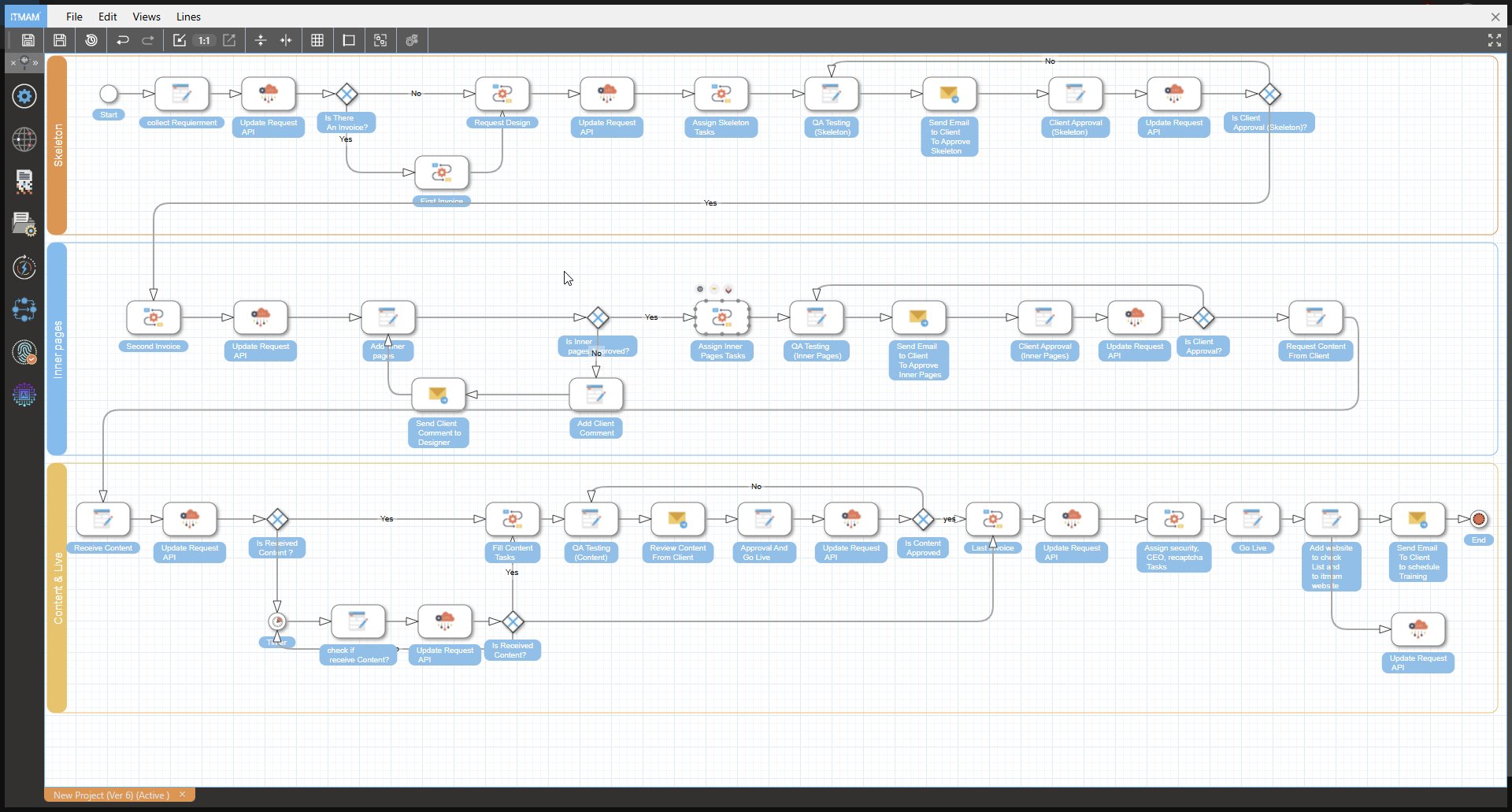
The diagram is the workflow.
Most BPM tools treat BPMN as a documentation step. You draw the diagram, hand it to engineering, and they re-implement it in code. The diagram drifts from reality the moment a developer hits a constraint nobody anticipated.
IJRA@ inverts that. The diagram is the executable artifact. When a business analyst saves the model, the engine begins running it on the next instance — no compilation, no translation, no ceremony. Production behaviour is exactly what the diagram describes. There is nowhere for the gap to hide.
The diagram you draw on Tuesday is the workflow that handles your customers on Wednesday.
Every BPMN element. Fully typed.
The modeler ships with the complete BPMN 2.0 vocabulary — start, intermediate and end events; user, service and script tasks; exclusive, inclusive, parallel and event-based gateways; sequence, message and conditional flows; pools and lanes for cross-functional choreographies.
| Element | Use | Configuration |
|---|---|---|
| User Task | Human-driven step with a form | Form binding, role assignment, SLA |
| Service Task | Automated REST/SOAP/DB call | Endpoint, auth, mapping, retries |
| Exclusive Gateway | One-of-N branching | Rule expression per outgoing flow |
| Parallel Gateway | Fan-out / join | Token splitting and synchronisation |
| Timer Event | Scheduled trigger or boundary | Cron, duration, or process variable |
| Message Event | Inbound webhook / outbound publish | Channel binding |
Every node, fully configurable.
Click any node to open its property panel. Every behaviour — including what data flows in, what flows out, who can act on it, what the retry policy looks like, and what the escalation chain says — is exposed declaratively. There is no “and then add some code in this hook” escape hatch. There is no hook, because the property panel is the contract.
- Inputs & outputs: map process variables to node parameters via expressions or visual mapping.
- Authorisation: bind tasks to roles, departments or per-instance user computations.
- SLA & escalation: set deadlines, define what happens when they slip.
- Retry & compensation: declare what happens when a downstream service fails.
- Error handling: attach boundary events to catch business exceptions cleanly.
Test it before you ship it.
Before deploying a new version, run instances against historical data, against scripted scenarios, or against fresh synthetic input. The simulator walks the same engine that production uses, with the same rules, the same integrations (in mock mode), and the same SLA timers compressed to seconds. You see exactly which paths fire, which gateways branch where, and where bottlenecks would form.
This means the most disruptive question in process work — “are you sure this won't break in production?” — has a concrete answer.
Every change. Immutable. Auditable.
Every saved version of the model is preserved indefinitely. Running instances continue on the version they started — you don't break someone's in-flight loan application because you tweaked the approval matrix. New instances pick up the new version automatically. The audit log records who changed what, when, and why.
Roll-back, side-by-side diff, and policy-driven approval flows for changes themselves are all built in.